Most fence material guides cover the same generic ground. Wood requires maintenance. Vinyl is low-maintenance. Chain link is affordable. Aluminum is durable. That framework is not wrong, but it’s incomplete, because material performance is climate-specific, and the Pacific Northwest makes demands on fencing that a national guide will never account for.
Persistent moisture through a seven-month wet season, freeze-thaw cycles, aggressive moss and algae growth, and intense summer UV exposure change how every fence material behaves. Here is what that actually looks like for each material, filtered through the conditions of a Portland-area property.
Generic Fence Guides Miss the Most Important Variable. Your Climate.
The PNW climate has a few defining characteristics that matter directly for fencing. The wet season runs October through May, keeping surfaces consistently damp and organic material active. Winter temperatures fluctuate around freezing, creating cycles that stress any material with pores or joints. And year-round, the combination of moisture, shade, and debris creates ideal conditions for moss, algae, and mildew to establish on almost any surface left untreated. Run any fence material through those conditions honestly, and a clearer picture of what will and will not hold up begins to emerge.
Wood Fencing in the PNW: What Moisture and Moss Actually Do Over Time
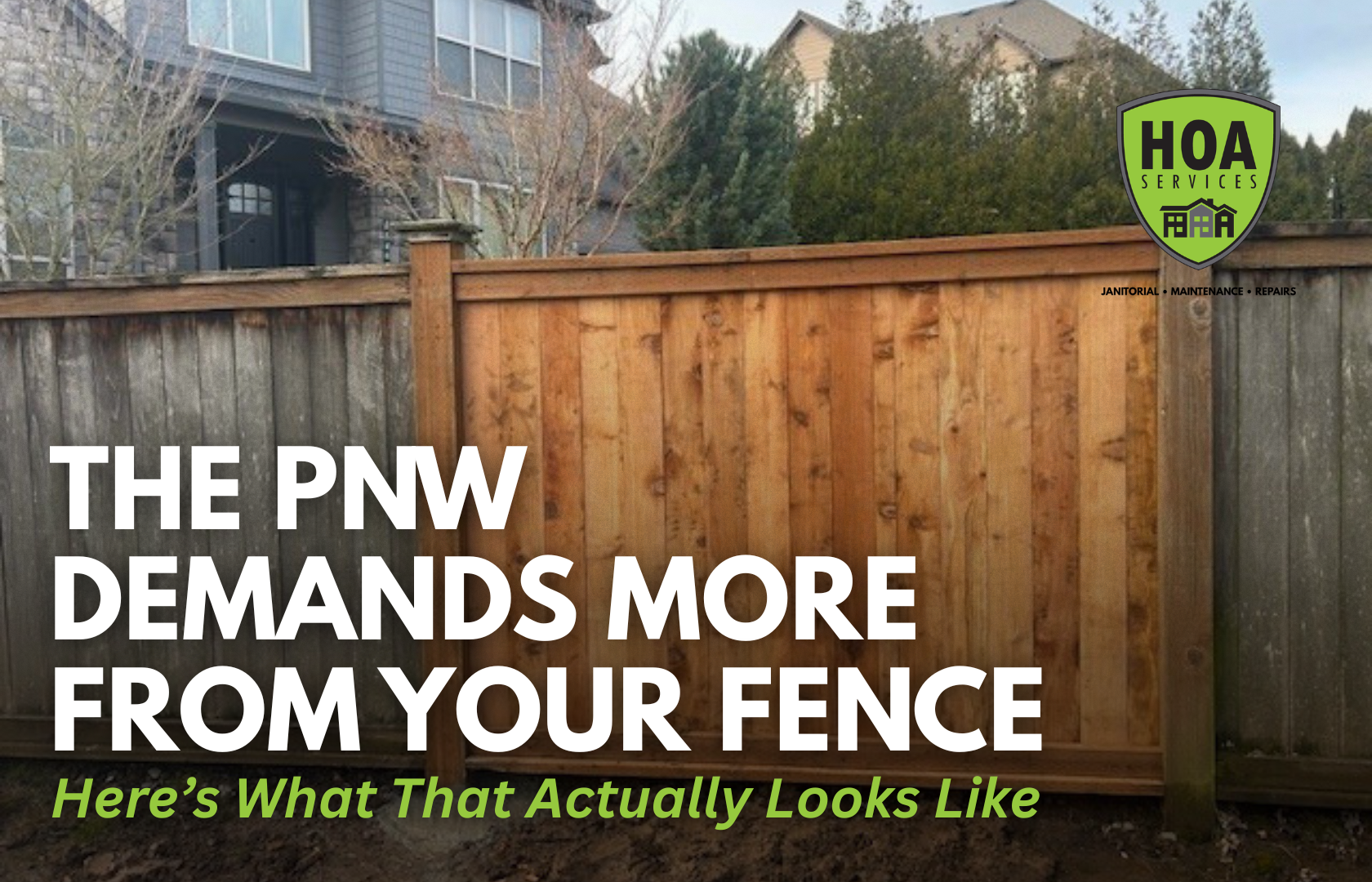
Wood is the most common fence material on PNW properties, and its vulnerability to the local climate is well-earned. Sustained moisture exposure causes wood fibers to swell and contract repeatedly, loosening fasteners and joints over time. Moisture trapped at post bases accelerates decay from the ground up, which is where most wood fence failures originate. Moss and algae establish readily on damp, shaded fence lines and hold additional moisture against the surface.
Wood is not a poor choice here, but it requires a realistic maintenance commitment. Sealing or staining every two to three years is not optional in this climate. Cedar and pressure-treated lumber significantly outperform untreated wood, and proper post installation with drainage and treated bases extends service life considerably across a multi-family or HOA property.
Vinyl Fencing: Where the Low-Maintenance Promise Holds and Where It Does Not
Vinyl’s genuine advantages in wet climates are real. It does not absorb moisture, does not rot, and does not require sealing or staining. Moss and algae cannot penetrate the surface the way they damage wood, limiting structural risk.
What vinyl is not immune to is cold-weather brittleness. At or below freezing, vinyl becomes susceptible to cracking on impact, and cracked panels require full replacement rather than spot repair. For properties where equipment or debris could contact fencing during winter months, that brittleness is worth factoring in. Vinyl also performs best when installation accounts for expansion and contraction at rail and post connections, a detail that affects long-term performance more than most property managers realize.
Chain Link Fencing: The Honest Case for a Material That Gets Overlooked
Chain link does not generate much enthusiasm, but it deserves an honest assessment. Properly galvanized or vinyl-coated chain link resists corrosion through extended wet seasons without the active maintenance wood demands. Freeze-thaw cycles do not stress it the way they stress porous materials. And repairs are straightforward: damaged sections can be replaced without touching adjacent areas.
For commercial properties, multi-family perimeter fencing, and utility enclosures where function matters more than aesthetics, chain link is frequently the most durable and cost-effective choice for this climate. Its limitation is appearance, and for HOA communities with aesthetic standards, that limitation is often decisive.
Aluminum Fencing: Where It Performs Well and Where It Falls Short
Aluminum does not rust, holds a powder coat finish well, and offers a clean aesthetic that works for HOA communities and decorative perimeter applications where chain link is not appropriate. Its primary limitation is that it’s an open, ornamental style. It provides boundary definition without privacy screening, which makes it the wrong category for applications where visual privacy is the goal.
Powder-coated aluminum performs reliably in persistent PNW moisture, but impact damage or installation errors that compromise the coating at cut edges can introduce corrosion over time. Specifying adequate coating thickness and proper edge treatment at installation are details that affect long-term performance meaningfully.
How PNW-Specific Conditions Should Drive Your Final Material Decision
The practical conclusions from running these materials through PNW conditions are straightforward. Wood works well when aesthetics and privacy are priorities and a maintenance plan is in place. Vinyl works well when maintenance simplicity is the priority and cold-weather impact risk is low. Chain link is the right call for functional and perimeter applications where durability outweighs appearance. Aluminum fits ornamental and boundary applications where rust resistance and clean aesthetics are the key criteria.
For properties with fencing across a large footprint, matching material to the function and visibility of each fence line often produces a better result than applying one material uniformly across the entire property.
Installation and Repairs That Account for How Your Fence Will Actually Be Used
Material selection is only part of the equation. In the PNW, installation quality determines how long any fence performs. Post drainage and base treatment are the variables that most directly affect wood fence longevity. Expansion gaps in vinyl rail connections prevent buckling through temperature swings. Chain link tensioning in saturated soil requires proper technique to maintain alignment over time.
HOA Services installs and repairs wood, vinyl, chain link, aluminum, and panel fencing for multi-family communities, HOA properties, commercial buildings, and retail centers throughout the greater Portland metro and Willamette Valley area. If your property’s fencing is due for inspection, repair, or replacement, contact HOA Services for an estimate today.