
Dryer vent cleaning is a maintenance task that tends to get scheduled, checked off, and forgotten until the next cycle. For most property managers, the assumption is straightforward: a vendor comes out, cleans the vents, and the risk is addressed. What rarely gets examined is whether the method used actually removes the debris that makes dryer vents dangerous in the first place.
There is a meaningful methodological difference in how dryer vents get cleaned, and for multi-family and HOA properties with complex vent systems, that difference has real consequences. Understanding it does not require technical expertise. It just requires knowing what to ask.
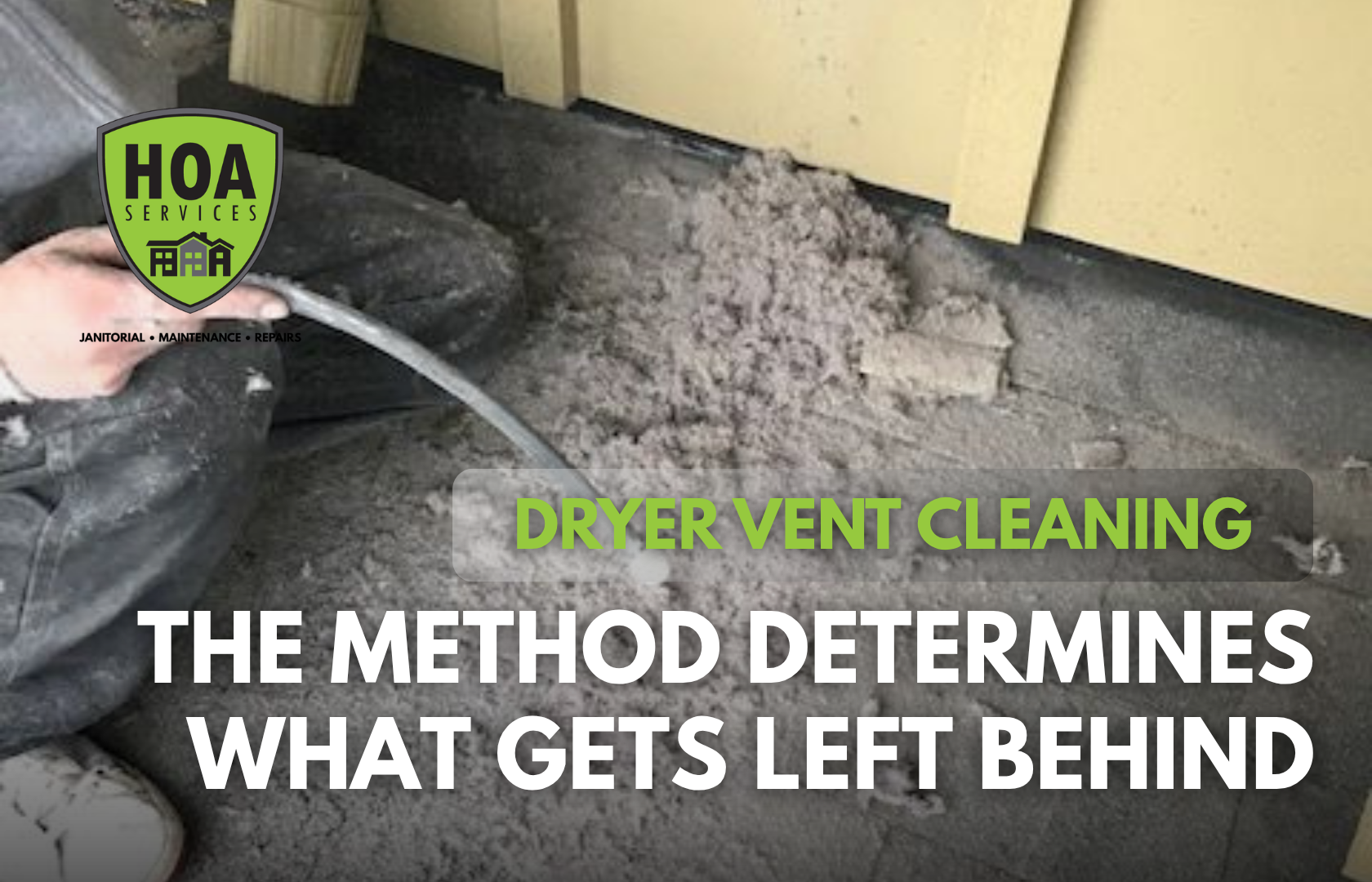
Is Your Dryer Vent Cleaning Actually Working?
Clogged dryer vents are one of the leading causes of residential fires, and for multi-family properties where dozens or hundreds of units share a building, the stakes are correspondingly higher. A routine cleaning schedule is a responsible baseline.
The problem is that “cleaned” is not a uniform standard. Depending on the method your vendor uses, the equipment they bring, and the configuration of your vent system, the result can range from a thorough removal of accumulated lint to a surface-level pass that leaves the most problematic buildup exactly where it was. If you are not asking about method, you may be paying for a service that is only partially delivering on its purpose.
How Lint Accumulates in Multi-Family Dryer Vent Systems
In a single-family home, dryer vents are typically short and relatively straightforward. In a multi-family building, the picture is more complex. Vents run longer distances, navigate more bends, and in some configurations, multiple units share a common exhaust pathway. Each of those variables creates additional opportunity for lint to accumulate and compact.
Lint does not distribute evenly through a vent run. It tends to collect at bends, transitions, and any point where airflow slows or changes direction. In longer runs, that means significant accumulation can develop well inside the vent, at distances that a surface-level cleaning approach never reaches. That interior buildup is where the fire risk lives, and it is also the hardest to remove with conventional equipment.
What Conventional Suction Methods Miss in Longer Vent Runs
Conventional suction-based dryer vent cleaning works by pulling debris back through the vent toward the point of entry. The limitation is physics. Suction loses effectiveness over distance, particularly in longer vent runs with multiple bends. Debris that has compacted at interior points in the system may be loosened by the suction force but not fully extracted, leaving behind residual lint that continues to accumulate and compress with each dryer cycle.
For shorter, simpler vent configurations, suction can be adequate. For the longer, more complex vent runs common in multi-family and HOA properties, it frequently is not. The result is a vent that looks serviced from the exterior but retains meaningful debris accumulation further inside the system.
Why Compressed Air Removes More Debris Than Suction
HOA Services uses a compressed air system with a specialized blasting attachment rather than conventional suction. The mechanical difference is significant. Compressed air drives a high-pressure stream through the full length of the vent, dislodging compacted lint and debris from bends, transitions, and interior accumulation points that suction cannot reliably reach.
Because the air pressure travels outward through the vent rather than pulling inward, it is not limited by distance in the way suction is. Debris that has built up well inside a long vent run gets pushed through and expelled at the exterior, rather than being partially loosened and left in place. The result is a more complete removal of the material that poses the actual risk.
Cleaning From the Exterior: Why Direction Matters for Debris Removal
The direction of cleaning matters as much as the method. HOA Services cleans dryer vents from the exterior of the building, blowing debris outward through the vent termination point. This approach prevents loosened lint and debris from being displaced into the interior of the building or back into the unit, which is a real risk when cleaning is performed from the inside without the right containment setup.
Cleaning from the exterior with compressed air also allows the crew to vacuum and bag all expelled debris directly at the vent termination point, removing it from the property entirely. There is no residual material left on the ground, in the vent cover, or anywhere on the building exterior. The job is complete when the debris is gone, not just dislodged.
For vents that are not accessible from the exterior, including those with booster fans or interior-only access points, HOA Services documents those units separately and coordinates interior access to ensure they receive the same thorough treatment.
What a Partially Cleaned Dryer Vent Still Risks
A dryer vent that has been serviced but not fully cleared still carries meaningful risk. Residual lint accumulation continues to build with each dryer cycle, compressing over the existing layer that was not removed. The timeline to a problematic restriction shortens, and the fire risk that the cleaning was meant to address remains.
Beyond fire risk, partial vent restriction affects dryer performance. Units that are venting through a partially blocked system run longer cycles, consume more energy, and experience accelerated wear on heating elements and mechanical components. For property managers fielding maintenance requests from residents about dryers that are not performing, a partially cleared vent system is a common and frequently overlooked cause.
A thorough cleaning, performed with the right method, addresses both the safety concern and the performance issue in a single service visit.
What to Ask Your Vendor Before the Next Service Visit
The right questions are simple. Ask whether your vendor uses compressed air or suction. Ask whether they clean from the exterior or the interior. Ask how they handle longer vent runs and units with booster fans. Ask what they do with the debris once it is expelled.
If your current vendor cannot answer those questions clearly, that is useful information. A thorough dryer vent cleaning is not just about showing up on schedule. It is about using a method that actually removes what needs to be removed, across every unit on your property.
HOA Services provides property-wide dryer vent cleaning for multi-family communities, HOA properties, and commercial buildings throughout the Portland Metro and Willamette Valley. Their team documents vent conditions, flags any units requiring follow-up interior access, and coordinates the full service through a dedicated account executive.
If your property is due for dryer vent cleaning, or if you are not certain the last service was thorough, now is the right time to find out. Contact HOA Services for an estimate today.