Most parking garage cleaning problems are caused by vendors using the wrong equipment. Power washers and floor scrubbers solve different problems, and a vendor who shows up with only one is guessing at your garage’s condition instead of assessing it.
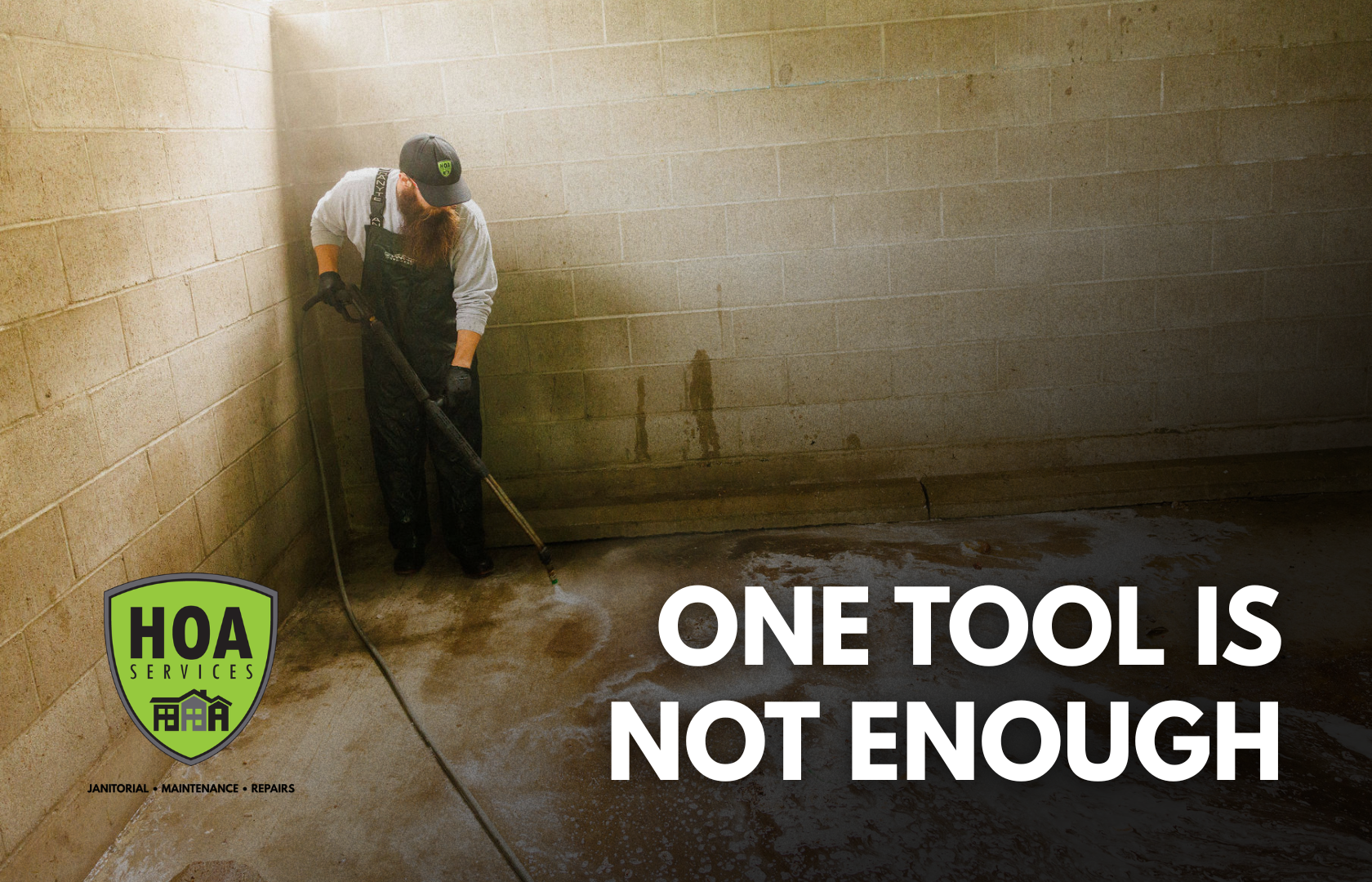
Floor Scrubbers and Power Washers Do Different Jobs. Knowing Which One You Need Changes the Outcome.
A power washer relies on water pressure to move debris off a surface. A floor scrubber relies on mechanical agitation, usually a rotating brush or pad combined with a cleaning solution, to loosen material and then extract it. Both machines leave a garage floor looking cleaner. Only one of them is built to deal with debris that’s worked its way into the concrete over months of vehicle traffic.
Power Washing Moves Surface Debris Fast. It Doesn’t Always Reach What’s Embedded in the Concrete.
Concrete is porous. Oil, grease, brake dust, and de-icing residue don’t just sit on top of it. They soak in over time, especially in high-traffic bays and near entrance ramps where vehicles idle or turn. Pressure washing alone rinses the surface but still leaves that embedded layer behind. In the moment, the garage looks clean, but weeks later, the same stains resurface.
Floor Scrubbers Agitate and Extract Contaminants. That’s Why They Handle Oil and Grease Differently.
A scrubber’s brush action breaks the bond between contaminants and concrete pores. The extraction pass pulls the contaminants out, rather than just spreading it around. This matters most in spots where power washing falls short, like parking stalls with regular oil drip, loading zones, or any area with concentrated vehicle dwell time. Floor scrubbing may be more time consuming than pressure washing, but it’s also the difference between removing a stain and rearranging it.
A Vendor Who Shows Up With Only One Tool Already Made a Decision. They Just Have Not Told You.
A crew with only a power washer assumes your garage has surface debris. A crew with only a scrubber assumes the opposite. Neither assumption is based on your property. Both are based on what equipment was loaded on the truck that day.
Routine maintenance relationships avoid this problem entirely. A technician who has serviced your garage on a set schedule already knows where the oil drip stalls are, which ramp transitions collect brake dust, and how traffic patterns have changed since the previous visit.
Property Assessments Determine the Right Equipment. Skipping This Step Costs You Later.
HOA Services assesses every parking garage before cleaning, because the right cleaning method depends on the property, not on a default service package. A garage with heavy oil buildup near a loading dock needs a different approach than a garage that mostly collects loose dirt and debris tracked in from outside. Assessing first means the equipment decision is made based on what the concrete, and your property, actually needs.
Mixed Surfaces and Traffic Patterns Change the Equation. Most Garages Actually Need Both Methods.
Few garages are uniform. Entrance ramps, standard parking stalls, and loading areas all experience wear differently, which means a single-method approach only treats some parts of the garage adequately while under serving the rest. Combining scrubbing in high-contamination zones with pressure washing for broader surface rinsing is often a more realistic answer than picking one tool for the entire structure.
The Wrong Equipment Choice Leaves Stains and Hazards Behind. Here Is What That Looks Like a Year Later.
Unaddressed grease and oil buildup doesn’t stay cosmetic. It becomes a slip hazard, particularly in areas where moisture and residue combine, and accelerates the breakdown of sealants and coatings on the concrete surface. What starts as a stain that pressure washing couldn’t fully lift turns into a maintenance issue that costs more to correct the longer it sits. At that point, you’re no longer paying to clean a garage. You’re paying to repair one.
Asking the Right Question Before You Hire Protects Your Property. Start With Their Equipment Process.
The simplest way to vet a parking garage vendor is to ask how they decide which equipment to use. A vendor who assesses the property first and explains why they are choosing scrubbing, pressure washing, or both is treating your garage as a specific job. A vendor who quotes a price before seeing the property is quoting based on convenience, not condition. This logic supports scheduled care under a program like Maintenance Shield, where equipment decisions get reassessed over time instead of locked in once.
FAQs
Do power washers remove embedded oil stains from concrete?
Not reliably on their own. Power washing clears loose surface debris well, but oil and grease that’s soaked into the concrete pore structure usually needs mechanical agitation to actually lift out. That is why oil stains often reappear shortly after a pressure-only cleaning.
When does a parking garage need a floor scrubber instead of a power washer?
Scrubbers are the better call for areas with concentrated oil, grease, or brake dust buildup, such as parking stalls with regular drip or loading zones with heavy vehicle dwell time. Power washing is more effective for broad surface rinsing where the issue is loose dirt and debris rather than embedded contamination.
How do property managers know which equipment their garage actually needs?
The most reliable way is a property assessment before any cleaning begins, since equipment needs vary by traffic pattern, surface condition, and contamination type within the same structure. A vendor should be able to explain which method they are using in which areas and why.
Is it normal for a cleaning vendor to only offer one cleaning method?
It happens often, but it’s worth questioning. A vendor with only one piece of equipment is limited to one type of solution regardless of what your garage actually needs, which means the equipment on hand is deciding the treatment instead of the condition of the property.
If your garage has stains that keep coming back no matter how often it gets cleaned, the equipment being used might be the reason. Request a parking garage assessment from HOA Services and get a cleaning plan built around what your concrete actually needs.