Most property managers know caulking exists somewhere on their property. Very few know it has a predictable failure timeline, and almost none are actively tracking when it was last replaced. That gap between awareness and action is where water intrusion begins, quietly and well before anyone notices.
The joints around your building’s windows, doors, and corners are the primary defense against water getting into the wall assembly. When that defense starts breaking down, the building does not send an obvious signal. It just starts letting water in.
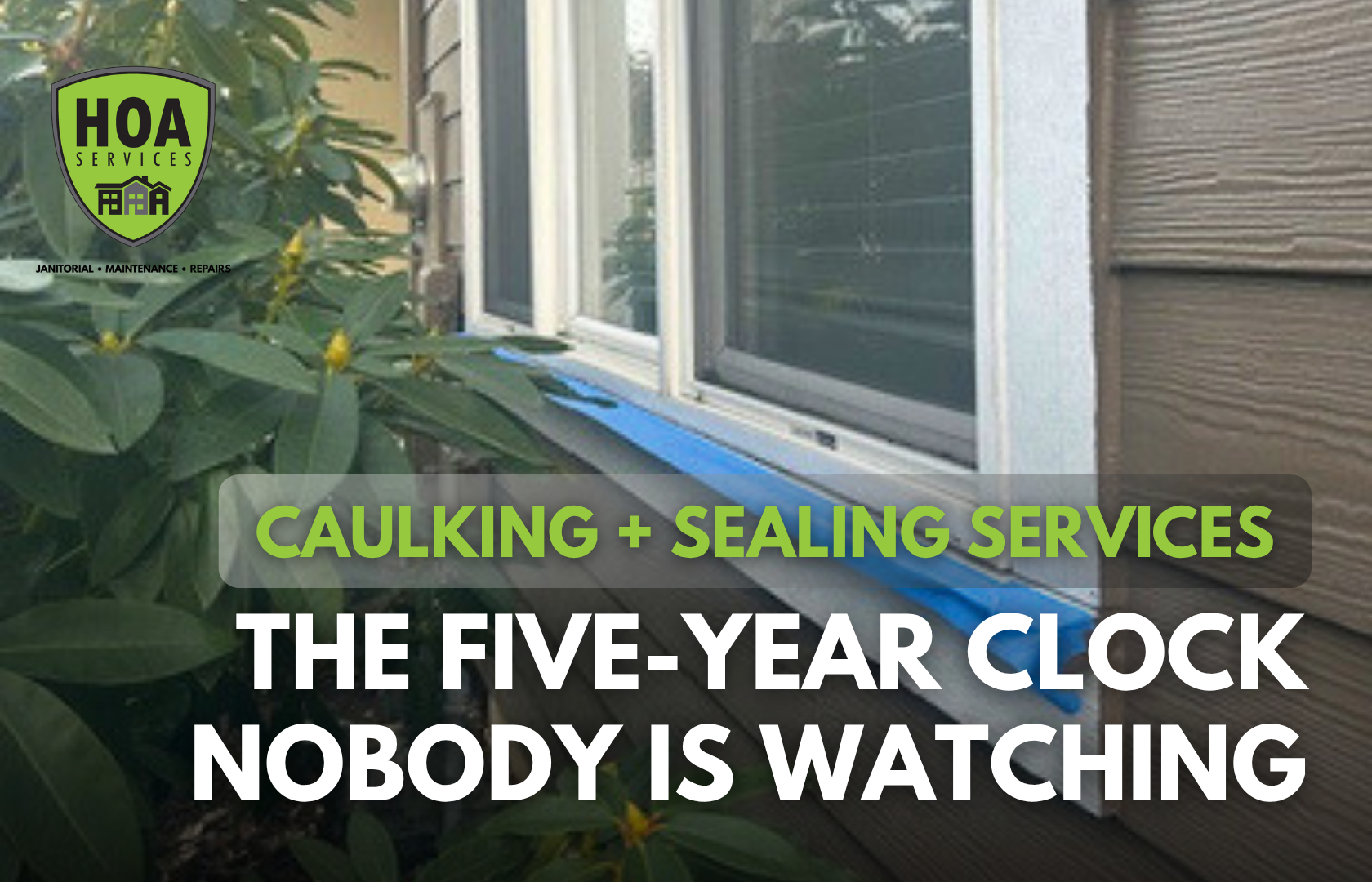
Caulking Has a Failure Timeline. Most Properties Are Not Tracking It.
Caulking joints around windows, doors, and corners typically begin failing around five years. That is not a worst-case estimate. It’s a standard service life for exterior caulk under normal conditions, and in the Pacific Northwest, conditions accelerate that timeline meaningfully.
Most property managers do not have a record of when their building’s caulking was last replaced. For properties that have changed management hands, that history may not exist at all. The practical result is that a significant portion of multi-family and commercial buildings in the Portland metro area are operating with caulking that is at or past its service life, with no inspection scheduled or replacement service on the calendar.
The five-year clock is not a guideline to note and move on from. It’s a maintenance interval that should be tracked the same way a roof inspection or dryer vent cleaning is tracked, because the consequences of missing it compound quickly.
What Caulking Actually Does and Why Its Location Matters
Exterior caulk fills and seals the gaps between building materials at the joints where different surfaces meet. Around windows and doors, those joints are where the frame meets the surrounding siding or trim. At building corners, caulk seals the seam where two siding panels or surfaces come together. At penetrations, it seals around any point where something passes through the building envelope: pipes, conduit, fixtures, and vents.
These are not incidental gaps. They are the points where the building envelope is structurally interrupted, and where water has a direct pathway into the wall assembly if the seal is compromised. A building with intact caulking at every joint is a building where water is being directed away from those pathways. A building with failed caulking is a building where water is finding them, whether or not anyone has noticed yet.
The Five-Year Clock: How Caulk Deteriorates in PNW Conditions
Exterior caulk deteriorates through a combination of UV exposure, temperature cycling, and moisture. In the Pacific Northwest, all three of those factors are significantly present. Dry summers bring UV exposure that breaks down caulk’s elasticity. The freeze-thaw cycles of PNW winters cause the building materials on either side of a caulk joint to expand and contract repeatedly, stressing the bond between the caulk and the substrate. And the sustained moisture of a seven-month wet season keeps caulk in contact with water for extended periods of time, accelerating the breakdown of adhesion at the edges.
The result is that exterior caulk on a PNW building is working harder than it would in a more moderate climate, and its effective service life reflects that. Five years is a reasonable planning horizon for inspection and replacement under these conditions, and for joints with high UV exposure or significant temperature swing, that interval may be shorter.
Early-Stage Failure Versus Advanced Failure: What Each One Looks Like
Understanding what caulk failure looks like at different stages is what makes proactive inspection possible. Early-stage and advanced failure look very different, and only one of them is easy to catch before damage occurs.
Early-stage caulk failure typically presents as surface cracking or crazing across the face of the caulk bead. The caulk may still be adhering at its edges but has lost enough elasticity that it can no longer flex with normal building movement. At this stage, the seal may still be marginally functional, but it is compromised and deteriorating with every weather cycle. This is the stage where replacement is straightforward, inexpensive, and fully preventive.
Advanced failure looks different. The caulk bead pulls away from one or both substrates, leaving a visible gap at the joint edge. In some cases the caulk shrinks, hardens, and separates entirely. In others it remains in place but has lost adhesion along its length, creating a channel behind the visible surface where water can travel. Advanced failure is visible to an experienced eye during inspection, but it’s not always obvious to someone who is not specifically looking for it.
Why Visible Damage Means Water Has Already Been Getting In
This is the part of the caulk failure conversation that most property managers find surprising. By the time caulk failure is obvious enough to notice without a close inspection, water intrusion has typically already been occurring for some time.
Advanced caulk failure does not happen overnight. The progression from early-stage cracking to full adhesion loss takes place over months, and during that time the seal is increasingly compromised. Water that contacts a partially failed joint during a rain event does not all run off harmlessly. Some of it finds the path of least resistance into the gap, and from there into the wall assembly behind the siding.
In the PNW, that process repeats across an entire wet season before the damage becomes visible from the exterior. By the time a property manager or board member notices staining, bubbling paint, or soft wall material, the moisture has been accumulating behind the surface for long enough to create conditions for mold growth, wood rot, and insulation degradation. The repair scope at that point is significantly larger than the caulking replacement that would have prevented it.
What a Proactive Caulking Inspection Actually Covers
A proper caulking inspection is not a quick visual pass from the parking lot. It requires close examination of every joint where caulk is present on the building envelope, with attention to both the surface condition of the caulk bead and the adhesion at its edges.
During an inspection, the crew evaluates every window and door perimeter, building corners and siding seams, penetrations through the exterior, and any previously repaired joints that may have been caulked with mismatched or lower-quality product. Findings are documented with photos that allow the property manager or board to see exactly what was found at each location, what the current condition indicates about risk level, and what the recommended scope of replacement work looks like.
For properties enrolled in the Maintenance Shield Program, caulking inspection is incorporated into the regular property walkthrough, and replacement is scheduled proactively based on documented condition rather than waiting for visible failure to prompt action.
Recaulking Before Failure Is Always Cheaper Than Repairing After It
The cost comparison here is not close. Proactive caulking replacement at the five-year mark is a straightforward scope of work: remove deteriorated caulk, prepare the joint surface, and apply new caulk at every window, door, corner, and joint on the building. The labor and material cost for that work is predictable and manageable.
The cost of addressing water intrusion that has been occurring through failed caulking joints for a full season or more is a different conversation entirely. Depending on the extent of infiltration, the repair scope can include siding removal, substrate replacement, mold remediation, insulation replacement, and interior repairs. None of that work is inexpensive, and all of it traces back to a maintenance interval that was not tracked.
HOA Services provides exterior caulking inspection and replacement for multi-family communities, HOA properties, commercial buildings, and retail centers throughout the greater Portland metro and Willamette Valley area. If your building’s caulking has not been inspected recently, or if you do not have a record of when it was last replaced, that is the right place to start. Contact HOA Services to schedule a caulking inspection and estimate today.